


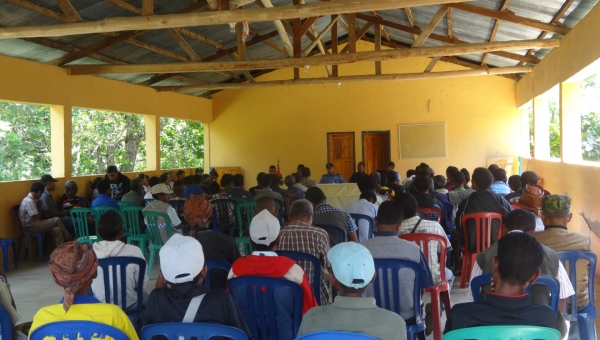
KDADALAK, Liquiça – As land disputes continue to threaten the livelihoods and survival of rural communities, the Popular Movement for Agrarian Reform–Liquiça (MPRAL) has reaffirmed its commitment to the collective struggle for land rights and agrarian justice through a base consolidation activity held in Fahilebo Village.
On 7 February 2026, the National Committee for Agrarian Reform, together with its allies—the Kdadalak Sulimutuk Institute, the Popular Education Institute, and the Ermera Farmers Union—conducted an MPRAL base consolidation with the participation of 35 members (10 women and 25 men) from the Brien Eran base and representatives of the Ermeta base in Bazartete Administrative Post, Liquiça Municipality.
This consolidation was not only part of preparations for MPRAL’s upcoming second congress, but also served as a space for political awareness and grassroots mobilization in response to ongoing land disputes affecting local communities. During the discussions, members raised serious concerns regarding unresolved land conflicts, weak base-level organizational structures, limited resources to support agrarian reform struggles, and inadequate access to information on land laws.
These conditions continue to leave rural communities vulnerable to exclusion, intimidation, and land dispossession—particularly in contexts where state mechanisms have failed to provide effective protection of farmers’ land rights. In this context, base consolidation becomes a strategic tool to strengthen collective organization, increase awareness of land rights, and reinforce solidarity among affected communities.
As a concrete act of collective resistance, members of the Brien Eran base—who have been affected by a land dispute covering approximately six hectares—decided to collectively reform and redistribute the land among members in the near future. This decision reflects the principles of agrarian justice and demonstrates that community-led solutions can emerge even amid political and institutional limitations.
MPRAL asserts that agrarian reform is not merely a public policy issue, but a fundamental human right for rural communities to ensure livelihood security, food sovereignty, and human dignity. Through base consolidation, MPRAL calls on the State to take responsibility by:
- ensuring fair and effective implementation of land laws,
- resolving land disputes through participatory and transparent mechanisms,
- protecting rural communities from arbitrary land appropriation, and
- recognizing farmers as key subjects and actors of agrarian reform.
The Fahilebo consolidation marks an important step in MPRAL’s ongoing preparation for its second congress, strengthening grassroots voices and advancing the agrarian reform agenda as part of the broader struggle for social justice in Timor-Leste. (**)

